Income Investor Perspectives

Independent municipal bond market insights for advisors

Muni Catchup 9/21

screen-shot-2016-09-21-at-3-38-55-pm

Are You Smarter Than an FOMC’er? (Part 3)

FOMC day feels like Groundhog Day–the same thing, repeating over and over again, so I’m just going to update and repeat what I published before in my “FOMC’er” posts in Part 1 and Part 2.

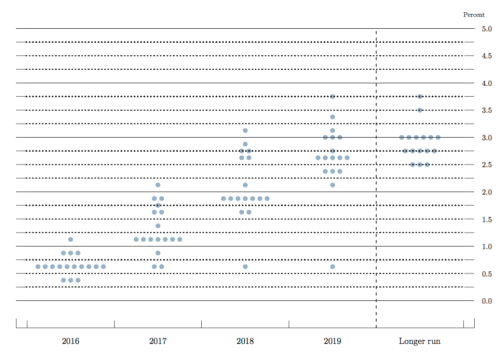
Here it is! What everyone’s been waiting for! (Well, maybe not everybody.) The new Dot Plot:

screen-shot-2016-09-21-at-3-42-28-pm

The big takeaway for me is not whether we’ll see a rate hike this year, but rather the diversity of opinion about where rates will be.

As I’ve noted before, even the members of the FOMC are not of one opinion, with participant’s assessments for the end of this year ranging from .375% to 1.125%. (How about the end of 2019? The range is 5/8 to 3 3/4!)

Which opinion is correct? Are any of them correct? There are so many variables at work, forecasting rates with precision is not realistic.

Yes–it makes sense for traders, hedgers and many others to be concerned and focused on the short-term movements in rates. But for investors, trying to time rates means that you are likely exposing yourself to higher risk by not being properly diversified.

8_ball_faceIf you really want to accurately forecast rates, read my article on how to do it. Or, for a short-cut, ask The Magic 8-Ball. (If the answer is anything other than “Reply hazy, try again,” don’t rely on it.)


Income Investor Perspectives

by Pat Luby

September 21, 2016

This is not investment advice. The opinions expressed and the information contained herein are based on sources believed to be reliable, but accuracy or appropriateness is not guaranteed. Past performance is interesting but is not a guarantee of future results. Investments in bonds are subject to gains/losses based on the level of interest rates, market conditions and credit quality of the issuer. Indices are not available for direct investment, although in some cases, there may be ETFs available designed to track some of the indices shown. The author does not provide investment, tax, legal or accounting advice. Investors should consult with their own advisor and fully understand their own situation when considering changes to their strategy, tactics or individual investments. Additional information available upon request.
©2016 Patrick F. Luby
All Rights Reserved

Muni Catchup 9/19


screen-shot-2016-07-11-at-6-52-25-am

Individual Ownership of Munis is Growing

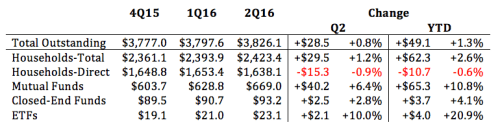
New data from the Federal Reserve show that individual ownership of municipal bonds grew in the second quarter this year–but what is interesting is that the growth has been in professionally managed munis. While direct ownership of individual munis declined by $15 billion in Q2, it was offset by increases in ownership of muni mutual funds ($40 billion), closed-end funds ($2.5 billion) and ETFs ($2.1 billion).

Muni ownership even increased among non-U.S. buyers and non-muni bond mutual funds. See the Muni Catchup 9/16 for additional insight about the holders data.

Muni ETFs are Growing

With all of the challenges in the market and economic environments, it is not surprising that individual investors are putting more money into professionally managed solutions, both active and passive. Even with the recent market volatility, money has continued to flow into muni bond mutual funds and muni ETFs. (See the Context page for the weekly update.)

While ETFs represent only about 4% of the muni fund assets, they have been attracting about 10% of the net new asset flow. That out-sized share of asset flows helps explain why Van Eck will be launching two new muni ETFs this week:

  • AMT-Free 6-8 Year Municipal Index ETF (ITMS). Estimated Duration 5.80
  • AMT-Free 12-17 Year Municipal Index ETF (ITML). Estimated Duration 7.30

As a point of reference, based on current benchmark rates and assuming new purchases of all par bonds, a hypothetical 10-year laddered high-grade (double or triple “A” rated) portfolio right now would have an average weighted duration of 5.19 with an average yield to maturity of 1.23%

If you’ve missed them before, here are link to my thoughts about how to select a muni ETF or how to combine muni ETFs into an existing portfolio bonds, Part 1 and Part 2.

Risks are Growing

In “A Sour Surprise for Public Pensions,” The New York Times provides an excellent illustration of the financial challenges facing many public pension funds. This is an issue that is growing in awareness, and the longer that low rates depress pension fund portfolio earnings, the dollar size of the issue will grow as well. It is likely that the magnitude of some of the numbers involved will be affecting municipal credit ratings and market liquidity. In case you missed it, I encourage you to also read Pensions & Transparency in the Muni Catchup 8/29. Better managing the risks of exposure to issuers with significant pension underfunding is one of the benefits of using professional management for a muni portfolio.

Market Wisdom

Because of the growing risks to investors, this week I am going to quote myself (is that cheating?):

The fundamental reasons to use a professional investment manager are when the investor does not have the time or the necessary expertise to properly make those decisions themselves.

From The Benefits of Professional Management.

The Bottom Line

The consensus about when The Fed will raise rates seems to shift with the breeze, but one thing seems clear: when it happens, the yield curve is going to move, and the longer maturities could move by just as much–or more–than short maturities. Of course, longer bonds have higher durations and would therefore be at a higher risk of a decline in market value. In other words, maintain a caution stance as it pertains to maturity selection.

Curve: while there is an incremental pick-up by going out to about 15 years, the duration in that part of the curve can be around 12 or higher. While holding bonds to maturity can offset duration risk, for most, it may be prudent to focus on shorter durations. (Keep in mind that it is possible to be too short in duration–lower volatility will most likely also mean less diversification to offset equity risk.)

Credit: is the economy improving? If so, credit spreads should tighten, offsetting some of the price erosion caused by a potential increase in rates. It’s never a good idea to overload on any one source of risk, and credit risk gone bad can be especially painful to exit, but holding a modest amount of credit risk is reasonable given the current environment, and can add some incremental income as well as diversification. If you’re holding or are thinking about adding non-investment grade bonds, consider hiring a professional manager–either through an SMA, mutual fund or an ETF.

Structure: premium bonds should still be favored for their lower duration and higher cash flow. If rates do continue to tick higher, the higher cash flow will be available to reinvest at  the higher prevailing rates.

Calls: rates could go lower, so beware of the total call risk in your portfolio. There are attractive opportunities right now for short call “kicker” bonds that would have higher yields to maturity if they don’t get called–but be sure that you are well compensated for that extension risk.

Products: muni bond mutual funds continue to have huge inflows. (Muni ETF flows have also been positive, but the dollar amounts are much less. See the Context page for recent data.) If those flows stop, that could take a lot of demand pressure out of the market, further pressuring muni prices. If the flows reverse, even investors who remain in those funds could get hurt by fellow shareholders heading for the exits.


Have a great week, and thanks for reading. Please let me know if you have any questions.

Pat

catchup-bottle-1132-by-468

This is not investment advice. The opinions expressed and the information contained herein are based on sources believed to be reliable, but accuracy or appropriateness is not guaranteed. Past performance is interesting but is not a guarantee of future results. Investments in bonds are subject to gains/losses based on the level of interest rates, market conditions and credit quality of the issuer. Indices are not available for direct investment, although in some cases, there may be ETFs available designed to track some of the indices shown. The author does not provide investment, tax, legal or accounting advice. Investors should consult with their own advisor and fully understand their own situation when considering changes to their strategy, tactics or individual investments. Additional information available upon request.
©2016 Patrick F. Luby
All Rights Reserved

Muni Catchup 9/16

Q: Are Munis Going Out of Style?

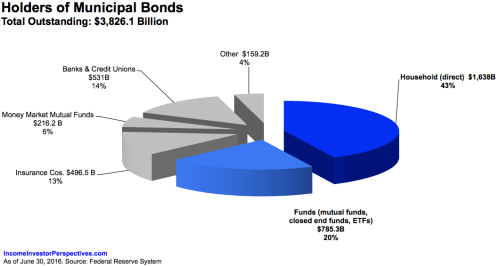
Direct ownership of individual municipal bonds went down in the second quarter, and is down for the year. Meanwhile, indirect ownership of munis through mutual funds, closed-end funds and ETFs grew. In fact, the growth in indirect ownership far exceeded the decline in direct ownership.

Municipal Securities: Household Direct and Indirect Ownership

screen-shot-2016-09-17-at-9-40-01-amSource: Federal Reserve, September 16, 2016. Dollar amounts in billions.

In the first half of the year, money market mutual fund holdings of munis declined by $52 billion–an amount that is not surprising given the pending changes with money market funds. (If you need a refresher on the reform, the ICI has a nice summary available here.)

While the municipal bond market is still dominated by individual investors, the relative value of munis continued to attract other buyers as well, as insurance companies added $7.4 billion in munis and banks added over $25 billion.

Even non-muni bond mutual funds were buyers of munis in the first half, adding $9.1 billion in munis. Foreign buyers added $2.2 billion to their munis holdings.

screen-shot-2016-09-16-at-5-29-30-pm

 screen-shot-2016-09-17-at-9-43-22-am

Liquidity

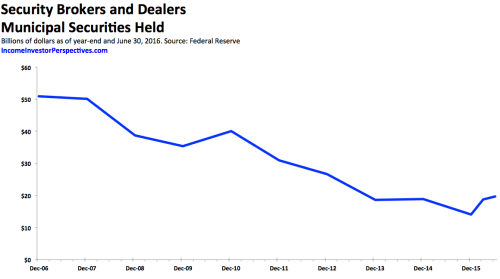
Looking at the amount of financial assets reported by broker-dealers as a proxy for their market-making activities (and therefore the depth of markets) reveals how liquidity for munis has declined over the last several years.

Since it peaked in 2006, broker/dealer support of the municipal bond market has declined by 61%. While there has been a recent uptick in support, as shown in the graph below, most longtime muni market participants are familiar with how much more difficult it can be to trade out-of-favor bonds. By using mutual funds or ETFs, however, investors are able to access liquidity through different and more predictable processes, perhaps explaining some of the growth in the flow into muni funds.

screen-shot-2016-09-16-at-5-39-10-pm

A: No.

Munis are not going out of style. Even with the recent decrease in ownership, direct ownership of individual muni bonds clearly remains very popular. In addition, there has been a large and growing appetite for  professionally managed munis in mutual funds, closed-end funds and ETFs. (See the Context page for additional information about recent muni bond mutual funds and ETFs flows.)

Income Investor Perspectives

by Pat Luby

September 16, 2016

Screen Shot 2016-07-11 at 8.44.33 AM

This is not investment advice. The opinions expressed and the information contained herein are based on sources believed to be reliable, but accuracy or appropriateness is not guaranteed. Past performance is interesting but is not a guarantee of future results. Investments in bonds are subject to gains/losses based on the level of interest rates, market conditions and credit quality of the issuer. Indices are not available for direct investment, although in some cases, there may be ETFs available designed to track some of the indices shown. The author does not provide investment, tax, legal or accounting advice. Investors should consult with their own advisor and fully understand their own situation when considering changes to their strategy, tactics or individual investments. Additional information available upon request.
©2016 Patrick F. Luby
All Rights Reserved


Muni Catchup 9/13

Ugly is a Strong Word — Part 2

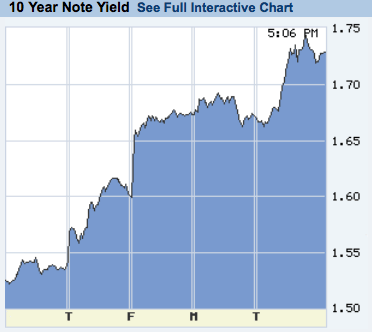
screen-shot-2016-09-13-at-5-07-34-pmIt was a painful day in the bond market (5-day chart of the U.S. Treasury 10-year note is below), so I’m just posting this in case you missed my article yesterday on Seeking Alpha, because it’s even more relevant now than it was yesterday.

Click here to read How Does A Bond Investor Get Defensive.


This is not investment advice. The opinions expressed and the information contained herein are based on sources believed to be reliable, but accuracy or appropriateness is not guaranteed. Past performance is interesting but is not a guarantee of future results. Investments in bonds are subject to gains/losses based on the level of interest rates, market conditions and credit quality of the issuer. Indices are not available for direct investment, although in some cases, there may be ETFs available designed to track some of the indices shown. The author does not provide investment, tax, legal or accounting advice. Investors should consult with their own advisor and fully understand their own situation when considering changes to their strategy, tactics or individual investments. Additional information available upon request.
©2016 Patrick F. Luby
All Rights Reserved


Muni Catchup 9/12

Screen Shot 2016-07-11 at 7.44.31 AM

Caution!

Year-to-date, most muni indices are still strongly in positive territory, but as shown on the Context page, the month-to-date indices are red as a tomato.

How can this be? Money is continuing to flow into the muni market–at least into mutual funds and ETFs, anyway.

The U.S. Treasury market has been much more volatile since Labor Day, and the muni market is not going to out-trade the Treasury market–at least not for long. In addition, the average trading flows in the last part of the year are typically lower than they are in the summer months, and new issue volume is picking up.

This is not to suggest that investors exit the muni market or hold off on putting money to work, but that they exercise caution. An old trader’s maxim comes to mind: “You make your money when you buy, not when you sell.”

Ugly is a Strong Word

The chart below is from The Wall Street Journal’s Market Data Center, and shows the last 10 days of trading for the U.S. Treasury 10-year note. Note the gap up in yields from Thursday to Friday. If you’re a trader looking for capital appreciation, this is an ugly chart–unless you were short the market.

Perhaps adding to the negative pressure on bond prices, DoubleLine CEO Jeff Gundlach made headlines on Thursday with his comment that, “Interest rates have bottomed. They may not rise in the near term as I’ve talked about for years. But I think it’s the beginning of something and you’re supposed to be defensive.”

However, if you are an investor starved for income, an uptick in yields can be a good thing.

screen-shot-2016-09-12-at-6-13-51-am

The crucial question, however, is how to react to this.

In the past, many investors have tried to time the market, and for years have been saying that they would wait for rates to go higher. While timing rates is nearly impossible, doing so also exposes investors to greater risks by leaving their portfolio unbalanced. Holding what should be a fixed income allocation in cash will not add any helpful diversification to the needed equity risks in a portfolio. As my friend Andy Martin has written in his excellent book, DollarLogic (see my review here), it is often better to reduce risk than it is to increase return and that to enjoy above-average long-term returns you need to focus on having smaller losses, instead of bigger gains.

So investors should be doing in here is exactly what Gundlach suggested in his comments: reduce duration.

If you need specific insight about ways to do that, take a look at these earlier articles on Using Duration as a Guide With Muni ETFs and on Van Eck’s MuniNation blog, Using Muni ETFs to Complement a Portfolio of Bonds and Muni ETFs in a Portfolio.

In addition, see my article today on Seeking Alpha, How Does a Bond Investor Get Defensive?

“Liquidity, Liquidity, Liquidity.”

SEC Commissioner Michael Piwowar spoke last week at FINRA’s Fixed Income Conference and had a lot to say. The speech is important reading for muni market professionals. Of particular relevance to advisors and investors is his summary of the current debate about bond market liquidity:

Some commenters are convinced that the reduction of dealer inventories and the high cost of capital resulting from post-crisis bank regulation mean that a single, large shock could cause the whole market to freeze up. Others see the way that fixed income markets have evolved over the past few years with large buy-side firms taking on some of the traditional roles of dealers, as well as fund managers stockpiling cash for the purpose of entering the market should there be a large sell off, and are persuaded that existing market dynamics are creating sufficient liquidity to withstand a large shock. With neither side able to provide conclusive evidence that a liquidity catastrophe either is, or is not, on the horizon, I am left with one conclusion: we all have more work to do. [emphasis added]

For market participants, that means dedicating resources to planning for future liquidity shocks and continuing to focus on innovations that may promote greater liquidity.

Importantly, note that he is not advocating for some regulatory “fix” for liquidity shocks, but that he advocates that everyone be better prepared for future shocks.

The Bottom Line

IMG_5760The caution flag is still flying, so here are a few thoughts of how to proceed.

Curve: while there is a nice slope in the muni curve out to about 15 years, the duration at 15 years can be around 12 or higher–holding bonds to maturity can offset duration risk, but for most, it may be prudent to focus on shorter durations. In a recent look at muni ETF flows, that is where I saw most of the money going–into the funds with durations between 4 and 8. Buyers in the cash market may want to start by looking in that same range.

Credit: is the economy improving? If so, credit spreads should tighten, offsetting some of the price erosion caused by an increase in rates. It’s never a good idea to overload on any one source of risk, and credit risk gone bad can be especially painful to exit, but holding a modest amount of credit risk seems reasonable given the current environment, and can add some incremental income as well as diversification. If you’re going to consider going into non-investment grade, consider hiring a professional manager–either through an SMA, mutual fund or an ETF.

Structure: premium bonds should still be favored for their lower duration and higher cash flow. If rates do continue to tick higher, the higher cash flow will be available to reinvest at  the higher prevailing rates.

Calls: rates could go lower, so beware of the total call risk in your portfolio. There are attractive opportunities right now for short call “kicker” bonds that would have higher yields to maturity if they don’t get called–but be sure that you are well compensated for that extension risk.

Products: muni bond mutual funds have had huge flows for months and months. (Muni ETF flows have also been positive, but the dollar amounts are much less. See the Context page for recent data.) If those flows stop, that could take a lot of demand pressure out of the market, further pressuring muni prices. If the flows reverse, even investors who remain in those funds could get hurt by fellow shareholders heading for the exits. Because of the liquidity and tax efficiency of ETFs, most muni investors should have at least a portion of their portfolio in muni ETFs.

Market Wisdom

Each issue, I’ll share one of my favorite investing quotes:

Predict yourself, not the market.

From DollarLogic by Andy Martin.

Let’s Catchup Together!

Munis have been added to the agenda for this year’s ETF.com Inside Fixed Income Conference!
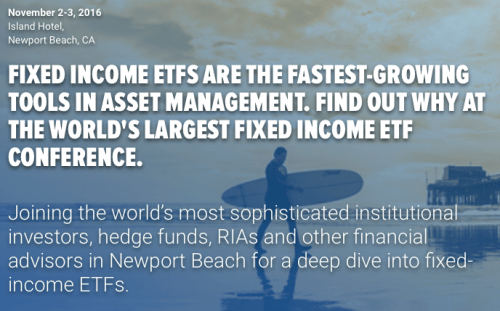
Screen Shot 2016-08-03 at 10.02.25 AMPlease come join me in Newport Beach this November for my presentation, “The Case for Muni Bonds: Active vs. Passive in the Puerto Rico Era.”

Click here to see the complete agenda and to register.

What’s Going on With You?

If you ever have a question or a concern about the muni market and feel that it would be helpful for me to get involved, please do not hesitate to use me as a resource.

Have a great week, and thanks for reading,

Pat

 

Catchup Bottle 1132 by 468This is not investment advice. The opinions expressed and the information contained herein are based on sources believed to be reliable, but accuracy or appropriateness is not guaranteed. Past performance is interesting but is not a guarantee of future results. Investments in bonds are subject to gains/losses based on the level of interest rates, market conditions and credit quality of the issuer. Indices are not available for direct investment, although in some cases, there may be ETFs available designed to track some of the indices shown. The author does not provide investment, tax, legal or accounting advice. Investors should consult with their own advisor and fully understand their own situation when considering changes to their strategy, tactics or individual investments. Additional information available upon request.
©2016 Patrick F. Luby
All Rights Reserved