

Income Investor Perspectives

Independent municipal bond market insights for advisors

Muni Catchup 8/15

Screen Shot 2016-07-11 at 8.44.33 AMThis Week in the Muni Catchup

  • 3 Fewer Muni ETFs
  • Speaking of Muni ETFs…
  • Caveat Emptor
  • The Wisdom of Buffett
  • The Bottom Line


3 Fewer Muni ETFs

State Street Global Advisors announced that 12 ETFs will be closing soon, and that among them are 3 muni bond ETFs that are sub-advised by Nuveen. (BABS, CXA and INY.) While the three that are closing are the smallest of the SPDR muni ETFs, it does seem surprising given the $45+ billion in inflows into the municipal fund market this year, that these three funds have not been able to attract more attention from investors. In particular, BABS, which is focused on taxable Build America Bonds, a part of the muni market which I have viewed as presenting an overlooked opportunity for investors seeking taxable income. (There is a weekly update of flows into muni open-end mutual funds and ETFs on the Context page.)

Speaking of Muni ETFs…

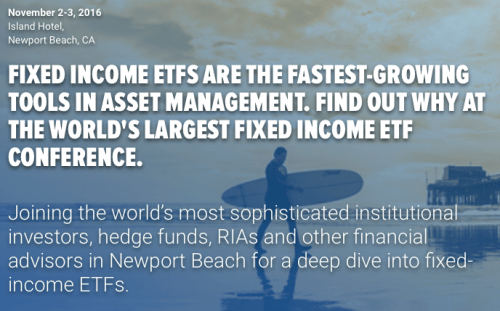
For the first time in several years, munis will be on the agenda for this year’s Inside ETFs  Inside Fixed Income Conference. There is a great line-up of speakers and ideas, so please consider joining me in Newport Beach in November. I will be presenting “The Case for Muni Bonds: Active vs. Passive in the Puerto Rico Era.”

Click here to see the complete agenda and to register.

Click here to read more of my articles about muni ETFs.

Caveat Emptor or Audentes Fortuna Iuvat?

Bloomberg reports the approval of a plan to issue $800 million in munis to finish construction of what Governor Christie called “the ugliest damn building in New Jersey, and maybe America.”

The bonds will be non-rated and when they come to market will no doubt offer investors a much higher yield than investment grade bonds.

“Buyer Beware”? Some investors may reject the bonds offhand simply because of the garish appearance of the buildings (see for yourself) or a general distrust of non-rated bonds.

Or, does “Fortune Favor the Brave”Other investors may be inclined to overlook some of the risks in order to pursue the promise of the higher yields.

Neither reaction is an appropriate way for the prudent investor to decide whether or not to buy. As Ben Graham wrote in The Intelligent Investor, “Operations for profit should be based not on optimism but on arithmetic.” (From Chapter 20, Margin of Safety.)

Self-directed investors who may be tempted to consider bonds such as these need to be honest with themselves about their ability to judge the merits and risks involved, and–even more importantly–their ability to maintain surveillance on the issuer’s ongoing financial condition. With rare exception, my preference would be that for investors for whom high yield is appropriate, consider using a professional manager to do so by investing with a high-yield open end mutual fund or one of the high-yield ETFs. Even for investors with a portfolio of individual bonds, adding a fund or an ETF to the portfolio is worth considering. (For additional reading, I recommend reading my article about The Benefits of Professional Management and my two articles published by Van Eck about adding ETFs to a portfolio of munis. See the links on my Bibliography page.)

So after the bonds are issued for American Dream, fund and ETF owners may see them show up in their underlying portfolios, but they will be there because the portfolio manager made a rational decision based on arithmetic–not an emotional decision based on a need for income or an aversion to an ugly building.

Buyer beware? Yes–always. And does fortune favor the brave? Perhaps, but in my experience, fortune more often favors the prepared.

NOTE: The Intelligent Investor is on my all-season list of recommended books.

IMG_5780The Wisdom of Buffett

Is it hot where you are? It’s hot here..it has been hot, and the forecast is for more hot. In fact, right now it is hotter where I live than this well-known destination. Even though they have wide easy roads that have been recently repaved, I do not want to go there.

A better course of action may be to slow down and chill out with some “Wisdom from Buffett.” It is especially in summer when I find that his insights and stories really resonate with me, but his timeless wisdom transcends seasons and appeals to young and old alike. I have always been impressed by how well he is able to express himself, which is why–as my family knows–I simply refer to him as The Poet. This week’s quote:

The more we learn the less we know
What you keep is what you can’t let go
Take it fast or take it slow
Just one way for you to go
Don’t chu-know

From Don’t Chu Know, by Jimmy Buffett

THE BOTTOM LINE

Check Your Calls: Didn’t believe that rates could go down again, did you? Declining rates can mean an increase in market value but also an unwelcome increase in call risk. If you hold premium bonds (and who doesn’t!), beware of how concentrated your call risk is–especially before you add any additional callable bonds to your portfolio.

Beware the Coupon: All other things being equal, lower coupons mean higher duration and therefore higher interest rate sensitivity. Add in the unfavorable tax treatment of market discount on munis and investors who do not plan on holding bonds to maturity should be wary of buying par or discount bonds.

Don’t Forget Taxable Munis! I’ve written this before, and I’ll write it again: Don’t Forget Taxable Munis! Notwithstanding the pending closure of BABS, investors who do not need the tax exempt feature of munis should compare the yields on taxable muni bond offerings versus comparably rated corporate bonds.

Curve Positioning: picking a spot on the curve is too much like trying to time rates–of which I am not a fan. Going out to the “bump” in the muni curve around 20-years can be tempting as there is not much incremental yield to incent investors to go further, and because of the slope of the curve, holding today’s 20-years bonds as they approach maturity may offer some nice price appreciation–if rates remain steady. But as shown on the Context page, 20-year par bonds can have a duration of close to 15–meaning that a 1% instantaneous increase in rates would mean a 15% decline in market value. That would hurt. So when you are looking at the curve positioning, check the duration. If you are considering funds, it can also be helpful to also check the correlation with your equity holdings. (See my recent article on ETF.com for additional insights on the topic.) Additions to your portfolio should reflect first and foremost what you need to get done with the money, not how you “feel” about the market.

If you are an advisor, please contact me if you need help deciphering any of this for yourself or your clients.

Have a great week, and thanks for reading,

Pat


IMG_5515This is not investment advice. The opinions expressed and the information contained herein are based on sources believed to be reliable, but accuracy or appropriateness is not guaranteed. Past performance is interesting but is not a guarantee of future results. Investments in bonds are subject to gains/losses based on the level of interest rates, market conditions and credit quality of the issuer. Indices are not available for direct investment, although in some cases, there may be ETFs available designed to track some of the indices shown. The author does not provide investment, tax, legal or accounting advice. Investors should consult with their own advisor and fully understand their own situation when considering changes to their strategy, tactics or individual investments. Additional information available upon request.
©2016 Patrick F. Luby
All Rights Reserved
Muni Catchup 8/4

Screen Shot 2016-08-04 at 6.19.23 AM

My latest article on muni ETFs was published today on ETF.com.

Municipal bond yields may be low, but the total returns for most municipal bond ETFs have been very strong—higher than some equity returns. In addition, over the last six months, almost all muni ETFs have been negatively correlated to SPY; yet some muni ETFs have been better diversifiers than others.

Read the article for details. You can also visit my author page while you’re there if you want to read my earlier articles on muni ETFs.


Muni Catchup 8/3

Join me at the ETF.com Inside Fixed Income Conference

Screen Shot 2016-08-03 at 10.02.25 AM.png

Munis have been added to the agenda for this year’s ETF.com Inside Fixed Income Conference!

I hope that you can be there for my presentation, “The Case for Muni Bonds: Active vs. Passive in the Puerto Rico Era.”

Click here to see the complete agenda and to register.

Muni Catchup 8/1

Screen Shot 2016-07-11 at 8.44.33 AMTHIS WEEK IN THE MUNI CATCHUP:

  • Overview
  • $30 Billion
  • College Football Playoffs!
  • The Bottom Line
  • The Wisdom of Buffett

Overview

Wow, did I make myself look smart! Out of the 206 municipal market indices published by S&P, 9 of the top 10 total returns for July were reported for taxable indices. Astute readers will recall that I have been reminding muni investors of the benefits of taxable munis, see the Catchups from 7/25 or 7/18 to confirm that. Although, to be honest, I’ll admit that my suggestions were not meant as a market call but as reminders that munis aren’t just for taxable accounts!

The top ranked S&P muni index for the month was the S&P Municipal Bond Defaulted Multifamily Index, but that is so far out of the usual area of interest for most muni investors that I won’t dwell on it here other than to remind readers that accessing that part of the muni market is best left to full-time professional management, so if you are inclined to defaulted or speculative grade munis, do it through a mutual fund or an ETF.

Screen Shot 2016-07-30 at 2.46.49 PM

Sorry…I didn’t mean to make the table into an eye test! Click here to open ito open it as a PDF.

Even with the soft total return performance for the muni market for July, the Year to Date and Trailing 12-Month total returns for most muni indices have numbers more like equity returns. See the Context page for more total return index data. Another example of my view that “Low Yields ≠ Low Return.”

As you’ll notice from the Yield Trend Table on the Context page, muni yields finished the month slightly higher, while Treasury yields ended noticeably lower. The news flow for the month pushed Treasuries around a lot…the political conventions, the FOMC meeting and the GDP report to name just a few influences.

The last table on the Context page is the recent recap of flows into muni bond mutual funds and ETFs, which have benefitted no doubt from the heavy flow of matured and called bonds in June and July (and probably will in August too), yet it is remarkable that the YTD inflows are well ahead of the last two calendar year totals. In my view, this is a result (at least in part) of investors needing to replace their earned income with portfolio income. Don’t be surprised if a jump up in yields–if it ever happens–also results in an additional bump-up in inflows to the muni market from yield-hungry investors.

$30 Billion

Yup…there will be an estimated $30 billion in munis redeemed in August. But you knew that already, didn’t you? All of that money will have to go somewhere. Some of it may not get re-invested until clients and advisors are back from the beach or the lake, but chances are a good chuck of it will stay in munis–either in bonds, funds or ETFs, likely providing some good buy-side interest.

College Football Playoffs!

There are only 106 business days left until the College Football Playoffs begin on New year’s Eve in the Peach Bowl. That’s not a lot of time…my recommendation is to procrastinate later, and get to work right now planning out the rest of the year to be sure you squeeze as much out of it as you can. There are only a few weeks left for you to print out your version of The Summer Thinking List–there’s one for advisors, and a short version for clients and prospects. This year’s lists are my all-time most viewed post. Do your self (and your clients) a favor and put them to use!

The Bottom Line

Check Your Calls: Premium are at an increased risk of being called away–this doesn’t mean that you should sell callable bond holdings, but it does mean that you should only add additional callable premium bonds after evaluating the concentration of call risk in your portfolio. It would also be sensible to evaluate what you would do if your callable bonds were called at their next call date.

Beware the Coupon: Favoring par bonds now may not be a prudent move for investors because of the potential exposure to the unfavorable tax treatment on market discount should rates move higher. If you are a buyer, continue to favor premium bonds–to reduce the risk of bonds moving to a discount if rates move higher.

Pay Attention to Duration, but Don’t Be Afraid of It: It may be tempting to put new money to work where performance has been the strongest (in long-duration bonds, funds or ETFs), but we all know that past performance is not an indicator of future returns. When the market turns, duration will be the total return investor’s foe. Unless you are an active total-return investor prepared to react quickly to market changes, new money should be put to work in line with the long-term goals as defined by your investment policy statement. But don’t be afraid of duration…it is possible to be too short on the yield curve. As can be seen in the yield curve on the Context page, there is a bump in the muni yield around the 15-year spot on the curve–going beyond that spot produces less incremental return for taking on the additional duration.

And still, Don’t Forget Taxable Munis! Investors with money in tax-deferred or other non-taxable accounts should compare the yields on taxable muni bond offerings versus comparably rated corporate bonds.

The Wisdom of Buffett

The dog days of summer are here…what are you going to do with them? Let’s see what we have this week from The Poet:


You need a holiday
take a holiday
find a far off wonderland
where you might regain command
of your life today

Take a holiday
you need a holiday
grab a pack and hit the trail
take a sail
and wind up in some moonlight bay

You’re caught up in the Internet
you think it’s such a great asset
but you’re wrong, wrong, wrong
All that fiber optic gear
still cannot take away the fear
like an island song

From Holiday, by Jimmy Buffett

It’s time for me to take a little holiday…no Catchup next week. See you on August 15!

Thanks for reading,

Pat


IMG_5515This is not investment advice. The opinions expressed and the information contained herein are based on sources believed to be reliable, but accuracy or appropriateness is not guaranteed. Past performance is interesting but is not a guarantee of future results. Investments in bonds are subject to gains/losses based on the level of interest rates, market conditions and credit quality of the issuer. Indices are not available for direct investment, although in some cases, there may be ETFs available designed to track some of the indices shown. The author does not provide investment, tax, legal or accounting advice. Investors should consult with their own advisor and fully understand their own situation when considering changes to their strategy, tactics or individual investments. Additional information available upon request.
©2016 Patrick F. Luby
All Rights Reserved

Muni Catchup 7/25

Screen Shot 2016-07-11 at 8.44.33 AM

This week in the Muni Catchup:

  • Fiduciary, Munis & You
  • Should All Munis Be Taxable? Part 2
  • Redemptions
  • Wisdom from Buffett
  • Summer Reminder
  • The Bottom Line


Fiduciary, Munis & You

Because most investors do not buy munis in their tax-deferred retirement accounts, municipal bond market participants may not have been paying close attention to the new Department of Labor fiduciary rule, which applies only to retirement accounts. However, a recent article in Investment News shows that the Department of Labor has been paying attention to the muni market, as shown by a recent clarification to the rule:

Originally, firms acting as principals would have been prohibited from directly purchasing and selling muni bonds from or into a client’s retirement account. The April version of the rule was changed to allow principals, which hold muni bond inventories, to purchase bonds from clients, essentially expanding the market of potential buyers of the bonds.

This is good for investors. The DOL clearly recognized that, particularly in times of market stress, there is no logical upside to limiting the universe of potential buyers of a security that an investor wants to sell.

However, for some reason, the DOL seems to be holding firm, for the time being, on not allowing principals to sell muni bonds out of its inventory to clients investing through their individual retirement accounts.

Jeff Benjamin, DOL fiduciary rule gets it half right on the municipal bond market. InvestmentNews, July 7, 2016.

This would seem to be irrelevant to the muni market because munis are rarely purchased in tax-deferred accounts. In practical terms, though, it is relevant for taxable munis (such as Build America Bonds), because they often offer higher yields than are available on comparably rated corporate bonds–making them attractive for purchase in retirement accounts.

Because the rule will disrupt how dealers will be able to re-distribute the bonds purchased from retirement accounts, the current equilibrium in the already illiquid taxable muni market may be upset, forcing yields (and yield spreads) higher to offset the reduction in potential demand.

Taking advantage of those higher yields may be more difficult, though, because of the coming changes in how market makers will be able to transact with retirement accounts. Rather than buying individual bonds, however, financial advisors and investors may find it easier to buy and manage their allocation to taxable munis by using mutual funds or ETFs.

Investors with tax-exempt portfolios, such as endowments and foundations, may an even more attractive opportunity since they will retain the ability to transact directly with the market makers.

Footnote: InvestmentNews has a page dedicated to their coverage of the DOL fiduciary rule.


Should All Munis Be Taxable? Part 2

As I explained in my special Catchup last week, it is not me asking that question, but it is the topic of a new research report published last week by The Tax Foundation. In addition to what I wrote last week, I had one more thought to share:

  • If Congress did move to reduce or eliminate the tax exempt status of munis, would that also prompt a move by the states to seek the ability to tax interest income from U.S. Government and Agency bonds?

You may also wish to read this article from Bloomberg about the potential for increased political risk to the tax-exemption from a narrowing investor base.


Redemptions

Screen Shot 2016-07-25 at 4.40.16 PMYes, Christmas is just five months away, but right now it is DEFINITELY still summer. The forecast high for today in my town was 99 degrees…which, as you can see, is hotter than another well-known place…

Meanwhile, in the air-conditioned comfort of the muni market, it is still Summer Redemption Season, which will conclude in August as an estimated $30.1 billion in redemptions will flow back to investors.

At current rates, many advisors and investors are be uncertain about how to reinvest–or even if they will want to reinvest in municipal bonds.

In addition to all of the factors that should normally be considered (issuer, credit rating, coupon rate, maturity date, call features, par amount, etc.), the decline in secondary market liquidity and the increase in political risk need to be managed more carefully than ever.  See The Bottom Line, below, for my current thinking.


The Wisdom of Buffett

There are only a few more weeks of summer, which means only a few more installments in my “Wisdom from Buffett” series. It is especially in summer when I find that his insights and stories really resonate with me, but his timeless wisdom transcends seasons and appeals to young and old alike. I have always been impressed by how well he is able to express himself, which is why–as my family knows–I simply refer to him as The Poet.

This week’s quote:

When I woke up this morning
I was tired as I could be
I think I was counting my money
When I should have been counting sheep

From Makin’ Music for Money, by Jimmy Buffett


Summer Reminder

What are you reading this summer?

To help you “digest” what you read this summer, be sure to also spend some time with The Summer Thinking List. This year’s edition is already my all-time most viewed post.
There are separate versions for advisors and investors, but don’t wait! Once Labor Day gets here, the lists will be taken down and put away until next summer.


The Bottom Line

Check Your Calls: Older callable bonds that are valued at a premium are at an increased risk of being called away–just as the reinvestment options have become less attractive. This doesn’t mean that you should sell callable bond holdings, but it does mean that you should only add additional callable premium bonds after evaluating the concentration of call risk in your portfolio. It would also be sensible to evaluate what you would do if your callable bonds were called at their next call date.

Beware the Coupon: Favoring par bonds now may not be a prudent move for investors because of the potential exposure to the unfavorable tax treatment on market discount should rates move higher. If you are a buyer, continue to favor premium bonds–to reduce the risk of bonds moving to a discount if rates move higher.

Pay Attention to Duration, but Don’t Be Afraid of It: As uncertainty clears and some of the recent global flows into bonds reverses, higher duration bonds and indices will be expected to underperform the rest of the bond market. So while it may be tempting to put new money to work where performance has been the strongest (in long-duration bonds, funds or ETFs), we all know that past performance is not an indicator of future returns. When the market turns, duration will be the total return investor’s foe. Unless you are an active total-return investor prepared to react quickly to market changes, new money should be put to work in line with the long-term goals as defined by your investment policy statement. But don’t be afraid of duration…it is possible to be too short on the yield curve. My discussion of duration in this article also applies to mutual fund and bond selection.

Don’t Forget Taxable Munis! Investors with money in tax-deferred or other non-taxable accounts should compare the yields on taxable muni bond offerings versus comparably rated corporate bonds. But as I noted above (in Fiduciary, Munis & You), it is now time to be paying attention to how you buy taxable munis–especially in tax-deferred retirement accounts.

Thanks for reading! Let me know if you have any questions and have a great week.
Pat

Catchup Bottle 1132 by 468This is not investment advice. The opinions expressed and the information contained herein are based on sources believed to be reliable, but accuracy or appropriateness is not guaranteed. Past performance is interesting but is not a guarantee of future results. Investments in bonds are subject to gains/losses based on the level of interest rates, market conditions and credit quality of the issuer. Indices are not available for direct investment, although in some cases, there may be ETFs available designed to track some of the indices shown. The author does not provide investment, tax, legal or accounting advice. Investors should consult with their own advisor and fully understand their own situation when considering changes to their strategy, tactics or individual investments. Additional information available upon request.
©2016 Patrick F. Luby
All Rights Reserved