

Income Investor Perspectives

Independent municipal bond market insights for advisors

Monday Muni Catchup

IMG_5209This week’s Muni Catchup:

  • Context
  • Shifting Flows
  • Hazardous Conditions
  • Coming Attractions
  • And don’t forget…

Context

Screen Shot 2016-05-23 at 8.49.36 AM

Notice anything? Maybe like how U.S. Treasury rates have made a huge move? Ok, maybe not huge, and not big, but they have moved slightly higher, thanks to the chatter about the June FOMC meeting. And, did you also notice how the muni scale didn’t move as much?

Due to continuing very strong demand, the muni market is holding in pretty well. If the FOMC does move or the muni curve moves higher with the UST curve, market prices (and statement prices) can be expected to move lower. This means that there may be an opportunity in here for muni investors with bonds due in the next couple of months that could be sold at a premium to realize the gain now instead of waiting to receive par when their principal is returned. Generally speaking, taking taxable gains on munis is not often tax-efficient unless the holder has losses that can be used to offset against the gains. This is not tax or portfolio advice–consult with your own advisor before taking any action, but it could be worth reviewing your holdings and asking a few questions. This could be particularly worthwhile for investors with bigger portfolios and larger block size (say, 250M and larger). While awaiting the right bonds for reinvestment, don’t let your principal lay around doing nothing…muni ETFs can be used as a good liquid parking spot. If you haven’t used muni ETFs, read about How to Pick the Right Muni Bond ETF and also Duration as a Guide With Muni ETFs so that you can maintain a similar risk exposure.

While we are here (and since I have included the Muni / Treasury Ratio in the table above), let me add a comment about the Muni / Treasury yield ratios. Rather than thinking of the ratio as an indicator of rich / cheap, think of it as a barometer of the market. When the ratio is moving higher, it means “fair weather” in the Treasury market. (The Treasury market is outperforming the muni market.) When the ratio is falling, it means “fair weather” in the Muni market. Since most muni investors (whether individual bonds, mutual funds or ETFs) should be more concerned about how munis will help them reach or satisfy their goals, the fact that munis are extraordinarily cheap versus Treasuries should not–in and of itself–mean that an investor should be adding to their muni position. But the ratios are helpful as a gauge of how the muni market is trading relative to the largest and most liquid global market.

Finally, my apologies to those who are offended when the decimal points don’t line up (and you know who you are). Next time I run it this table, I’ll start working on it a little earlier so that you won’t be distracted by the non-aligned decimals.

Shifting Flows

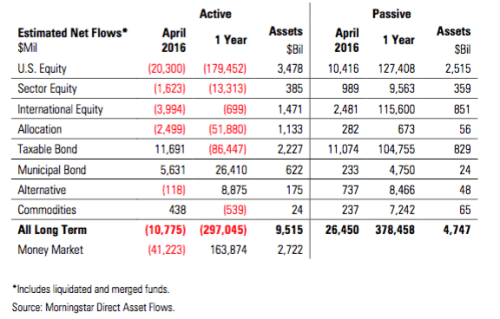
As noted in last Monday’s update, investors have been shifting many billions of dollars of assets into fixed income. And as I also noted last week, among municipal bond investors, mutual funds seem to have benefited from those flows by a much larger degree than ETFs have. A couple of days ago, the latest monthly U.S. Asset Flows Update from Morningstar Direct confirmed the observation:
Screen Shot 2016-05-18 at 9.17.42 AM

Note that for the trailing 12-months, muni ETFs have attracted 15% of the total new muni asset flows, yet in April mutual funds grabbed 96% of the total muni flows.

If you have comments or insights about why the shift towards active, I’d like to hear from you.

red-flag-908686_960_720Hazardous Conditions

Stay out of the water around Puerto Rico.

Our friend J.R. Rieger, Managing Director and Global Head of Fixed Income for S&P Dow Jones Indices put out an update on Sunday noting that there has been in bounce in the prices for Puerto Rico munis. This doesn’t mean that the coast is clear, but only that there are changing and potentially dangerous currents in the market for Puerto Rico bonds. Here’s the link to his article on Indexology.

Coming Attractions

What are you reading? More to the point, what are you thinking about?

There is a proliferation of summer reading lists, with everyone in the industry seeming to be telling everyone else what to read. I don’t know about you, but summer reading to me is Dirk Pitt, Ken Follett or Robert Ludlum. Maybe with a little Richard Feynman or George Weigel thrown in. Investing classics that are truly classics need to be read–and not just left for summer. So I do have a Summer / Fall / Winter / Spring reading list, but it doesn’t change very much from one year or season to the next unless there is something truly worthy of being added.

Last summer, rather than offering another reading list, I thought it would be more interesting to offer a list of things to think about, to help prepare for the back-end of the year. It was one of my most popular posts of the year.

So be on the lookout for my Summer Thinking List…Memorial Day and the unofficial start of summer are close, so I will be publishing an updated version of my list. This year, though, I will be publishing two lists: one for advisors, and one for investors.

And Don’t Forget…

Summer Redemption Season starts next week! Do you have bonds coming due on June, July or August? Do you have clients with bonds coming due? Should you roll them over into replacement bonds? Should you leave the principal in cash? Should you reallocate into another asset class? Should you use a muni bond mutual fund? Or an ETF? Over $100 billion in principal will be returned to investors in the next three months….where that money flows will have a big impact on the market. I updated the article to show the tops states for June redemptions. Be sure to read it.

The next Muni Catchup will be published Tuesday, May 31. Subscribe now to be notified when it is releasd.

Have a great week,

Pat

The opinions expressed and the information contained herein are based on sources believed to be reliable, but accuracy or appropriateness is not guaranteed. Past performance is interesting but is not a guarantee of future results. The author does not provide investment, tax, legal or accounting advice–this is NOT investment advice. Investors should consult with their own advisor and fully understand their own situation when considering changes to their strategy, tactics or individual investments. Investments in bonds are subject to gains/losses based on the level of interest rates, market conditions and credit quality of the issuer. Additional information available upon request.

Monday Muni Catchup

IMG_5209This week’s Muni Catchup:

  • Context
  • Muni Bond Fund Flows
  • Recap
  • Looking Ahead

Context

An article in the Financial Times (May 12, “U.S. Muni Bonds Unlikely Home for the Huddled Masses,” not linked since it is behind their pay wall) pointed out that an increasing number of non-U.S. investors are buying munis. Why wouldn’t they? Even with the lower yield because of the U.S. Federal tax exemption, muni yields are higher than what is available on many other high quality bonds around the world. When you factor in the lower default risk of munis versus corporates, it is actually surprising that more non-U.S. investors haven’t been bigger buyers of munis. Muni ETFs would be a particularly easy way to access munis. There are even two muni ETFs that specialize in taxable Build America Bonds. Click here to read about how to select a muni ETF.

Muni Bond Fund Flows

For all the headlines about the low-rate environment and objections to putting money into bonds (at least among commentators), investors have in fact been moving money into muni open-end funds and ETFs in a big way. It is interesting to note that after last year, when ETFs claimed a significantly larger percentage of the total flows, this year the proportion has dropped back down to be in line with 2014.

Total Flows Mutual Funds Mutual Fund / Total ETFs ETFs / Total

2014

$31,156 $27,988 90% $3,168 10%
2015

$18,722

$14,792

79%

$3,930

21%

2016 YTD

$23,213

$21,171

91%

$2,042

9%

2016 Annualized*

$67,060 $61,161 91% $5,899

9%

Source: Investment Company Institute weekly statistics release, May 11, 2016. Data as of May 4, 2016. Downloaded from ICI.org. 
*Not seasonally adjusted.

Recap

Heres a recap of what I published last week:

Looking Ahead

  • Due to the Memorial Day Holiday, SIFMA recommends that U.S. bond markets close at 2:00 ET on Friday, May 27, with a full close (of course) on Monday, May 30.
  • Wednesday, June 1 will be the official kick-off of Summer Redemption Season. Of the $38 billion in redemptions expected for June, about 80% will be in the top 16 states (in billions):
    • NJ   $6.6
    • NY  $5.7
    • CA  $5.6
    • FL  $1.8
    • CO  $1.6
    • PA  $1.4
    • OR  $1.3
    • OH  $1.0

Rounding out the rest of the top 16 with less than $1 billion each will be MA, NC, IL, WA, TX, LA, VA and CT.

It will be very interesting to watch to see how much of the maturing bond proceeds get re-directed into muni bond funds or muni ETFs instead of direct purchases of individual bonds.

Have a great week,

Pat

The opinions expressed and the information contained herein are based on sources believed to be reliable, but accuracy or appropriateness is not guaranteed. Past performance is interesting but is not a guarantee of future results. The author does not provide investment, tax, legal or accounting advice–this is NOT investment advice. Investors should consult with their own advisor and fully understand their own situation when considering changes to their strategy, tactics or individual investments. Investments in bonds are subject to gains/losses based on the level of interest rates, market conditions and credit quality of the issuer. Additional information available upon request.

Navigating Puerto Rico

Screen Shot 2016-05-11 at 10.06.27 AMWhile most muni investors probably do not need to be worried about what’s going on with Puerto Rico bonds, everyone should be paying attention because the precedents being set now could affect how easy it will be for the next issuer that feels forced to choose which of their promises to honor.

I have published two articles recently on ETF.com about Puerto Rico and muni ETFs. Read Puerto Rico’s Lesson for ETF Investors for insights about political risk and These ETFs Hold Puerto Rico Munis if you are wondering if you should be selling your ETFs.

You can also visit my author page for other articles about munis and ETFs.

This is not a recommendation to buy, sell or hold any of the securities or strategies mentioned. The author does not provide investment, tax, legal or accounting advice. Investors should consult with their own advisor and fully understand their own situation when considering changes to their strategy, tactics or individual investments. Information is based on sources believed to be reliable, but its accuracy is not guaranteed. Additional information is available upon request.


Muni Monday Catchup


IMG_5209The Yield Curve

How far is too far? How short is too short? Should you go shorter to reduce interest rate risk? Should you go longer to get a positive real return (yield minus inflation rate = real return)? How can you decide without spending so much time that you’ll be late for your tee time?

Investors often draw an artificial line, and decide not to go past that line. That is one reason why there is often an extra bump-up in yield for going slightly longer than 10-years–because a lot of demand gets crowded into the 10-year maturity, there can be less demand and more supply by going just a little longer. I have always paid attention to what percentage of the yield curve is captured by specific spots on the curve. Right now, it looks like this:

  • 60% 14-years
  • 70% 16-years
  • 80% 19-years
  • 90% 23-years

This doesn’t mean you should focus on one of these spots, but it can be a helpful point to keep in mind as you balance risk and return.

The Redemption Wave is Coming

The Summer Redemption Season starts in only a few weeks, and while the expected $100+ billion in redemptions will have an impact on the market, keep in mind that the muni market is not a single homogenous market, but a variety of markets spread across the states and in some cases the sectors as well. So it’s important to keep in mind that the heavy redemption flow starts in a handful of states. Of the $38 billion in redemptions expected for June, about 80% will be in the top 16 states (in billions):

  • NJ   $6.6
  • NY  $5.7
  • CA  $5.6
  • FL  $1.8
  • CO  $1.6
  • PA  $1.4
  • OR  $1.3
  • OH  $1.0

Rounding out the rest of the top 16 with less than $1 billion each will be MA, NC, IL, WA, TX, LA, VA and CT.

Puerto Rico’s Lesson for Muni ETF Investors

It can be hard to find good muni insight as it pertains to ETFs, so I have published a number of articles on ETF.com. The latest came out on Friday. You can check my author page to read my other muni ETF-related articles.

Have a great week!
Pat


The opinions expressed and the information contained herein are based on sources believed to be reliable, but accuracy or appropriateness is not guaranteed. Past performance is interesting but is not a guarantee of future results. The author does not provide investment, tax, legal or accounting advice–this is NOT investment advice. Investors should consult with their own advisor and fully understand their own situation when considering changes to their strategy, tactics or individual investments. Investments in bonds are subject to gains/losses based on the level of interest rates, market conditions and credit quality of the issuer. Additional information available upon request.

May 9, 2016.

©2016 Patrick F. Luby. All rights reserved.

I disagree!

What do you think is the secret to happiness?

One of my favorite sites on the web is Farnam Street Blog…favorite enough that it is among the few links I share on my “Links of Note.” My Sunday mornings include a review of the weekly digest e-mail that the author, Shane Parrish, sends out.

One of the articles highlighted this week is about the secret of happiness,

There are so many people who don’t know what they want. And I think that, in this world, that’s the only thing you have to know — exactly what you want. … That’s the way to be happy.

So the way to be happy is to know exactly what you want? I disagree. Suggesting that happiness comes from knowing what you want (and pursuing it) strikes me as materialistic. What happens when you don’t get what you want? Knowing what you want is important, but it will not bring happiness.

The secret to happiness is gratitude:

Each of us enjoys countless blessings, more than we can count or even identify. The opposite of gratitude is the sense of entitlement–that somehow we deserve that which we have not earned.

But we do not earn blessings–they are given to us, and there is no quid pro quo with blessings. Even the fruits of our labors–what we have built or earned–ultimately depend on what we have received from others.

It doesn’t matter what you know, so long a you are grateful.