Income Investor Perspectives

Independent municipal bond market insights for advisors

The Case for Muni ETFs

screen-shot-2016-10-10-at-5-28-09-pm

Join me in Newport Beach at the world’s largest fixed income ETF conference, where I will present “The Case For Muni Bonds: Active Vs. Passive In The Puerto Rico Era.”

Click here to see the complete agenda or to reserve a seat.

screen-shot-2016-10-10-at-5-38-27-pm

Muni Catchup 10/10

seeing-red2This week in The Muni Catchup:

  • Seeing Red
  • Duration is No Longer Your Friend
  • Market & Calendar Preview
  • Market Wisdom
  • Money Market Fund Assets & Flows
  • The Bottom Line

Seeing Red

Take a look at the recent month-by-month total returns for the muni market and you’ll see that even though the YTD returns are positive, the recent trend suggests a change in momentum.

screen-shot-2016-10-08-at-11-30-58-am

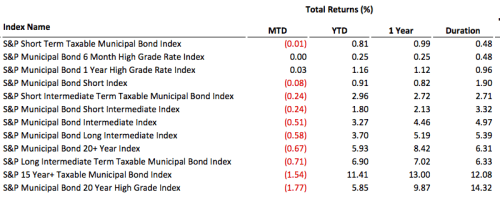
As shown in the table below, duration is no longer your friend. When the bond markets are rallying (prices rising/yields declining), more duration often can mean more return, but when the market shifts, more duration can mean more downside risk. With the end of the week sell-off in bonds, the performance of the S&P Dow Jones muni indices revealed the impact of higher duration. (The list below is sorted in duration order.)

screen-shot-2016-10-08-at-1-13-32-pm

By the way, I’m assuming that you have already looked at and printed out this week’s Context page. If you haven’t, please go do that now.

Preview

Even with the 4-day week in the bond market, new issue muni supply remains robust, with $8.4 billion scheduled for the week. The U.S. Treasury will be auctioning 3, 10 and 30-year debt this week, so the Treasury market is likely to remain soft in advance of that new supply coming into the market. However, keep in mind that bond fund flows remain positive, so if there is strong enough demand to absorb this week’s heavy muni and Treasury supply, don’t be surprised if yields finish the week lower.

Important Dates

10/10 Monday Columbus Day stocks open / bonds closed
10/12 Wednesday Yom Kippur
10/14 Friday effective date for Money Market Fund reform
11/1 & 2 Tue & Wed FOMC meets
11/2 & 3 Wed & Thu Inside ETFs: Inside Fixed Income 2016
11/8 Tuesday Election Day
11/11 Friday Veterans Day stocks open / bonds closed
11/24 Thursday Thanksgiving Day all U.S. markets closed
12/13 & 14 Tue & Wed FOMC meets
12/25 Sunday Christmas Day
12/25 Sunday Chanakuh begins
12/26 Monday Christmas Observed all U.S. markets closed
12/30 Friday Last Trade Date of the year bonds close early

Here’s a link to the complete economic calendar on the MSRB’s EMMA website.

Market Wisdom

Targeting arbitrary hurdles quickly leads to undisciplined and, in the end, unproductive, investment management.

From Due Diligence, by Christopher Carosa.

This quote points out the importance of planning as the necessary prerequisite to investing. None of us can control the market or the returns available, but we can control our asset allocation, investment selection and costs. Yes, it is important to watch the benchmarks to follow the market, but it is also important to have a plan (or investment policy) and to stick with it.

Money Market Funds Update

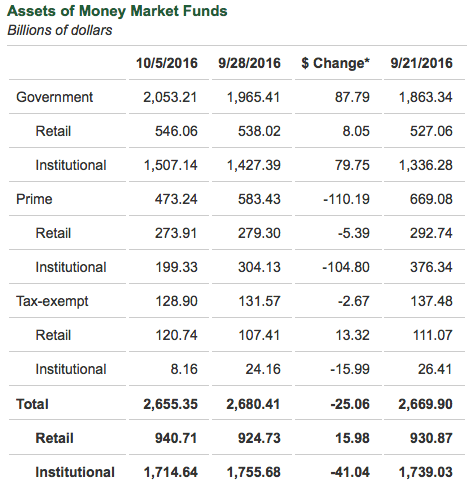
Tax-exempt money market funds declined by $2.6 billion last week, but the big number there is the continued dramatic decline in the assets for institutional tax-exempt money market funds. If you missed it, see last week’s Catchup for more background on money market fund reform.

screen-shot-2016-10-08-at-12-41-48-pm

Source: ICI

The Bottom Line

Shortened week and heavy supply may present some buying opportunities for investors.

Curve: Continue with the cautious stance as it pertains to maturity selection. For investors with new money to put to work or reinvest, favoring the shorter end of your maturity (or duration) target range can make sense.

Credit: Holding a modest amount of credit risk can add some incremental income as well as diversification. If the economy continues to improve and pushes rates higher, that should also tighten credit spreads, which could offset some of the duration risk. But as always, if you’re thinking about adding non-investment grade bonds, consider hiring a professional manager–either through an SMA, mutual fund or an ETF.

Structure: Premium bonds remain favored for their lower duration and higher cash flow. Some pre-refunded bonds have been offered at more than 100% of Treasury yields recently, making the yields attractive for “pre-re” buyers.

Calls: Beware of the total call risk in portfolios. There are attractive opportunities right now for short call “kicker” bonds that would have higher yields to maturity if they don’t get called–but be sure that you are well compensated for that extension risk. If you are going to accept call risk, be sure that you are getting paid to do so.

Products: Muni bond mutual fund and ETF inflows continue to be positive. Favor lower duration solutions.

Sellers: Investors who will be selling should pay attention to the calendar and the overall tone of the bond markets–watch the 10-year U.S. Treasury for direction. If the Treasury auctions do well, look for a better bid-side to the market later in the week.

Have a great week, and thanks for reading. Please let me know if you have any questions.

Pat


screen-shot-2016-07-11-at-6-52-25-am

This is not investment advice. The opinions expressed and the information contained herein are based on sources believed to be reliable, but accuracy or appropriateness is not guaranteed and are subject to change without notice. Past performance is interesting but is not a guarantee of future results. Investments in bonds are subject to gains/losses based on the level of interest rates, market conditions and credit quality of the issuer. Indices are not available for direct investment, although in some cases, there may be ETFs available designed to track some of the indices shown. The author does not provide investment, tax, legal or accounting advice. Investors should consult with their own advisor and fully understand their own situation when considering changes to their strategy, tactics or individual investments. Additional information available upon request.
©2016 Patrick F. Luby
All Rights Reserved

Muni Catchup 10/3


screen-shot-2016-07-11-at-6-50-17-amThe last week of the quarter ended on a positive note for the bond market, with most yields finishing slightly lower. But, the trend across the quarter was choppy. Looking ahead, with decelerating fund inflows, a large pipeline of new issue supply and a lot of calendar distractions, caution remains the watchword.

This week in The Muni Catchup:

  • Q3 Recap
  • Q4 Preview
  • Don’t Forget About Money Market Reform
  • Market Wisdom
  • The Bottom Line


Q3 Recap

The last week of the quarter ended on a positive note, with most bond market yields finishing slightly lower. The trend across the quarter, however, has been choppy–note the negative monthly returns for the key bond market indices in the quarter. YTD total returns remain positive, but have been drifting lower because of the recent weakness in the bond market.

screen-shot-2016-10-02-at-4-09-13-pmIn the muni market, the heavy flow of redemptions in June, July and August ($38, $33 and $30 billion, respectively for this year) have traditionally lead to strong reinvestment demand–demand that has also tended to taper off after Labor Day. (This fall’s estimated redemptions: Sept $19B, Oct $19B, Nov $18B and Dec $28B.)

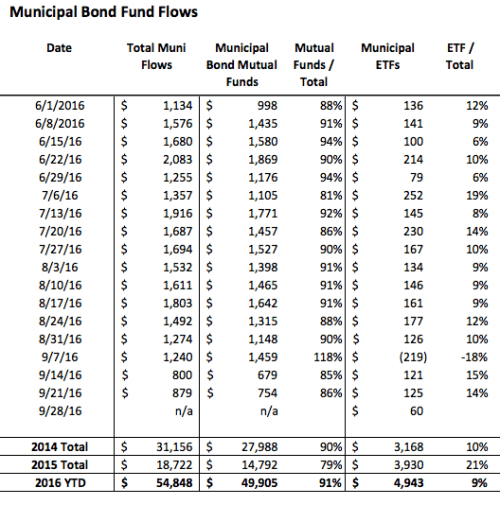
Using mutual fund flows as a proxy for overall demand tends to reinforce that view–note the peaks in recent total flows in June and July when redemption flows peaked. Note also the recent deceleration of inflows.
screen-shot-2016-10-01-at-11-12-26-am

Flows in millions in dollars.

Q4 Preview

If demand is waning, supply is waxing. The Bond Buyer reports year-to-date muni issuance of $334 billion, a pace that could get close to or eclipse the record annual volume of $433 billion, set in 2010. September issuance totaled almost $36 billion, and future supply appears heavy, with $14.2 billion in deals scheduled just for this week.

Placing the heavy flow of new issues with investors will be challenged by the fourth quarter calendar, which is filled with distractions. Of the 13 weeks in the quarter, 5 of them will be shortened or interrupted by holidays or holy days. (Including this week.)

Important Dates

10/3 & 10/4 Mon & Tue Rosh Hashana
10/10 Monday Columbus Day stocks open / bonds closed
10/12 Wednesday Yom Kippur
10/14 Friday effective date for Money Market Fund reform
11/1 & 2 Tue & Wed FOMC meets
11/2 & 3 Wed & Thu Inside ETFs: Inside Fixed Income 2016
11/8 Tuesday Election Day
11/11 Friday Veterans Day stocks open / bonds closed
11/24 Thursday Thanksgiving Day all U.S. markets closed
12/13 & 14 Tue & Wed FOMC meets
12/25 Sunday Christmas Day
12/25 Sunday Chanakuh begins
12/26 Monday Christmas Observed all U.S. markets closed
12/30 Friday Last Trade Date of the year bonds close early

If you subscribe to The Wall Street Journal, here’s a link to their economic calendar. The same economic calendar is also available on the MSRB’s EMMA website.

Market Wisdom

The portfolio with the least uncertainty may have an undesirably small “likely return.”

Harry M. Markowitz, Portfolio Selection

Don’t Forget About Money Market Fund Reform

The muni market has been affected by the approaching October 14 deadline for the implementation of reforms to money market funds.

In addition to requiring a floating NAV for institutional funds, the regulations include provisions to potentially impose liquidity gates and fees on retail and institutional money market funds (but not governmental money market funds). Investors have responded by shifting assets within the fund types, drastically reducing the demand for some securities–including short-term municipal bonds but more importantly for commercial paper, which has been cited by some as the leading driver to the recent increase in LIBOR (see Context).

Since January 2015, prime and tax-exempt money market funds have seen a decrease in assets of $1.00 trillion, in response to the Securities and Exchange Commission’s 2014 money market fund reforms, which must be implemented by October 14. During the same period, government money market funds have seen an increase in assets of $974.77 billion, and total money market fund assets have remained consistently close to $2.7 trillion.

Source: ICI

While the shift in assets has been orderly so far, there may be some additional shifts seen in advance of the deadline for funds to implement the new regulations, which are summarized here. The table below is from ICI.

screen-shot-2016-10-01-at-3-07-35-pm


The Bottom Line

If the slackening of flows into funds continues and if the heavy new issue calendar persists, there may be some buying opportunities for investors. It is possible too, though, that the heavy supply will draw in institutional buyers who favor the large round-lots available in new issues. If the heavy supply is placed well, that would be a good sign of healthy demand from buyers.

Curve: Continue with the cautious stance as it pertains to maturity selection. Going out to 10-years picks up almost half of the available yield in the curve (see the Context page for details), but with much less risk. You don’t have to draw an artificial line in the sand right at ten years, but do be sure that you understand how duration risk can impact market valuations.

Credit: Holding a modest amount of credit risk is reasonable given the current environment, and can add some incremental income as well as diversification. If the economy continues to improve and pushes rates higher, that should also tighten credit spreads, which could offset some of the duration risk. But as always, if you’re thinking about adding non-investment grade bonds, consider hiring a professional manager–either through an SMA, mutual fund or an ETF.

Structure: Premium bonds remain favored for their lower duration and higher cash flow.

Calls: Beware of the total call risk in portfolios. There are attractive opportunities right now for short call “kicker” bonds that would have higher yields to maturity if they don’t get called–but be sure that you are well compensated for that extension risk. If you are going to accept call risk, be sure that you are getting paid to do so.

Products: Muni bond mutual fund and ETF inflows continue to be positive, but the pace has slackened. If the inflows stop, that could take a lot of demand pressure out of the market.

An interesting note here is that Morningstar will be combining their ETF and mutual fund rankings soon. If some of the muni bond ETFs get ranked highly in the combined universe, it will be interesting to see if there is a shift in the percentage of fund flows going to ETFs.

Sellers: Investors who will be selling should pay attention to the calendar and the overall tone of the bond markets–watch the 10-year U.S. Treasury for direction.

Have a great week, and thanks for reading. Please let me know if you have any questions.

Pat

img_6057

This is not investment advice. The opinions expressed and the information contained herein are based on sources believed to be reliable, but accuracy or appropriateness is not guaranteed. Past performance is interesting but is not a guarantee of future results. Investments in bonds are subject to gains/losses based on the level of interest rates, market conditions and credit quality of the issuer. Indices are not available for direct investment, although in some cases, there may be ETFs available designed to track some of the indices shown. The author does not provide investment, tax, legal or accounting advice. Investors should consult with their own advisor and fully understand their own situation when considering changes to their strategy, tactics or individual investments. Additional information available upon request.
©2016 Patrick F. Luby
All Rights Reserved

Muni Catchup 10/1

Working on your Q3 recap?

img_6057The Context page is now updated, with additional data points to help place some context around the third quarter numbers.

Watch for my regular Muni Catchup early on Monday morning.


Muni Catchup 9/26

screen-shot-2016-07-11-at-6-50-17-am

State Tax Revenues Decline

A new report on state tax revenues from The Nelson A. Rockefeller Institute of Government should raise credit concerns for muni bond investors.

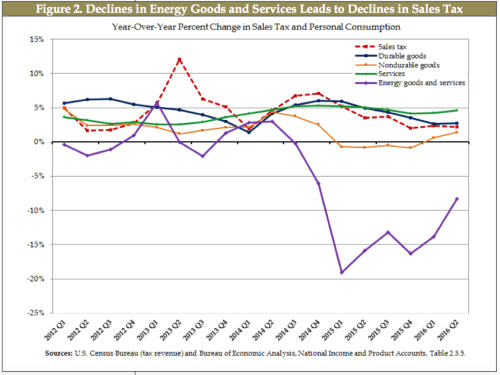
State and local government taxes have continued a slowdown that began in the middle of 2015 and that has extended into the second quarter of 2016. State and local government revenue from major taxes tracked by the Census Bureau grew by 3.0 percent in the first quarter of 2016, the most recent quarter for which we have full details, which is a substantial slowing from the 5.4 percent average for the four previous quarters.

Total state tax revenue from all sources grew by 1.6 percent in the first quarter and preliminary data for the second quarter of 2016 indicate declines of 2.1 percent. The declines in state government tax revenues in the second quarter appear to have been driven by the weak stock market of 2015, and by slowing growth in sales tax and withholding collections.

The outlook for state budgets in the 2016-17 state fiscal year, which began on July 1st in forty-six states, remains gloomy.

State Revenue Report, September 2016.

Even though most local governments earn the bulk of their tax revenue from property taxes, state tax revenues are important both as an indicator of economic conditions and because of the dependence of so many local governments on state revenue sharing.

screen-shot-2016-09-26-at-6-52-25-am

While these trends may not be a reason to take immediate action, they do bear watching–particularly for self-directed investors with exposure to issuers with a narrow margin of financial safety.

Have You Been Waiting on The Fed?

Hurry up and wait! Well, according to new data, muni investors have not been waiting on the Fed. In fact, individual investors have been adding exposure to munis. In case you missed it, please see my article on ETF.com or the special Catchup from 9/16.

The Dot Plot

Fed watchers were anxiously awaiting the pronouncement from last week’s FOMC meeting…in case you missed my comments, see my special Catchup 9/21.

The Bottom Line

Curve: Continue with a cautious stance as it pertains to maturity selection. Going out to 10-years picks up almost half of the available yield in the curve (see the Context page for details), but with much less risk. You don’t have to draw an artificial line in the sand right at ten years, but understand the duration risk of going longer out the curve.

Credit: It’s never a good idea to overload on any one source of risk, and credit risk gone bad can be especially painful to exit, but holding a modest amount of credit risk is reasonable given the current environment, and can add some incremental income as well as diversification. If you’re holding or are thinking about adding non-investment grade bonds, consider hiring a professional manager–either through an SMA, mutual fund or an ETF. (You saw my note above about the Rockefeller report, right?) Credit risk is often more correlated with equity risk than interest rate risk is, so overweighting your fixed income with credit risk may be reducing overall portfolio diversification. Be careful, and seek expert guidance if you need it.

Structure: Premium bonds remain favored for their lower duration and higher cash flow.

Calls: Don’t give away your call protection for free! Rates could go lower, so beware of the total call risk in your portfolio. There are attractive opportunities right now for short call “kicker” bonds that would have higher yields to maturity if they don’t get called–but be sure that you are well compensated for that extension risk. If you are going to accept call risk, be sure that you are getting paid to do so.

Products: muni bond mutual funds continue to have huge inflows. (Muni ETF flows have also been positive, but the dollar amounts are much less. See the Context page for recent data.) If those flows stop, that could take a lot of demand pressure out of the market, further pressuring muni prices, and if the flows reverse, even investors who remain in those funds could get hurt by fellow shareholders heading for the exits. For right now, though, the addition of two new muni bond ETFs from Van Eck is a good sign of demand and support for the market.


Have a great week, and thanks for reading. Please let me know if you have any questions.

Pat

catchup-bottle-1132-by-468

This is not investment advice. The opinions expressed and the information contained herein are based on sources believed to be reliable, but accuracy or appropriateness is not guaranteed. Past performance is interesting but is not a guarantee of future results. Investments in bonds are subject to gains/losses based on the level of interest rates, market conditions and credit quality of the issuer. Indices are not available for direct investment, although in some cases, there may be ETFs available designed to track some of the indices shown. The author does not provide investment, tax, legal or accounting advice. Investors should consult with their own advisor and fully understand their own situation when considering changes to their strategy, tactics or individual investments. Additional information available upon request.
©2016 Patrick F. Luby
All Rights Reserved