
Income Investor Perspectives

Independent municipal bond market insights for advisors

Muni Catchup 9/6

IMG_5760Caution Flag is Still Flying

Money is still flowing into the municipal market and year-to-date returns compare favorably with some equity indices. (See the Context page for details.) However, most municipal indices did not perform as well in August as they did in June or July, and the new issue supply is expected to pick up almost immediately now that Labor Day is past. Add in all of the political and Fed-related news headlines, and the next couple of months are likely to be even more “interesting” than the last couple of months have been.

How’s it going?

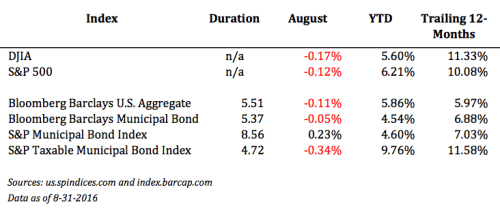
Here are some performance figures for selected indices. While the muni market has turned in a strong year-to-date total return performance, August was not as strong as prior months. Many of the S&P muni indices had positive returns for the month, but when month-to-month performance begins to slip, investors are advised to pay attention. It doesn’t necessarily mean sell. If it is in fact an indicator of future higher yields, that would mean lower market values for current fixed income holdings, but it could also mean higher investment returns for future purchases–welcome news in today’s yield starved market.

The potential for a softer market should of course also be reflected in investment selection–see my comments below in The Bottom Line.

Index Mod Dur June July August YTD Trailing 12-Mos
DJIA n/a 0.80% 2.80%   0.13% 7.03% 13.45%
S&P 500 n/a 0.09% 3.56%   0.06% 7.33% 11.80%
Bloomberg Barclays U.S. Aggregate 5.51 1.80% 0.63% -0.11% 5.86%   5.97%
Bloomberg Barclays Municipal Bond 5.37 1.59% 0.60% -0.05% 4.54%   6.88%
S&P Municipal Bond 4.72 1.63% 0.02%   0.23% 4.60%   7.03%
S&P Taxable Municipal Bond 8.56 2.15% 1.80% -0.34% 9.76%  11.58%
Data as of 8-31-2016. Sources: us.spindices.com and index.barcap.com

Three Seasons

Did you know that there are only 3 seasons? Of course you did, but perhaps you never realized it. I’m not talking here about the seasons as defined by the movement of the Earth, but the seasons as defined by human activity and how we actually live our lives each year: New Year’s until Memorial Day, Summer and then the time after Labor Day.

For many years, even though I had to do formal business plans based on quarters and years, my approach has been to schedule activities based on the three major parts of the year. I bring this up because this week we started a new season: the post-Labor Day “Fall” season, and the seasonal patterns in the muni market may surprise you because while most people may be expecting an uptick in business and client activity, in the municipal bond market, the “Fall” season for the last several years has not been the most active.

Municipal Bond Market Trading Activity

Year Daily Average Spring Summer Fall
2012 Par Amount (billions) $11.2 $11.6 $11.2
Number of Trades 38,505 39,359 37,322
2013 Par Amount (billions) $11.3 $11.8 $10.6
Number of Trades 39,522 46,406 41,394
2014 Par Amount (billions) $10.3 $9.9 $9.3
Number of Trades 37,471 34,611 32,945
2015 Par Amount (billions) $9.9 $8.6 $7.0
Number of Trades 37,966 38,130 33,563
2016 Par Amount (billions) $9.8 $11.4  ?
Number of Trades 36,836 33,968  ?

Spring: First business day of the year until the last business day before Memorial Day. Summer: First business day after Memorial Day until the last business day prior to Labor Day. Fall: The day after Labor Day until the last business day of the year. Source: MSRB trade data from emma.msrb.org.

The heavy activity in the Summer months makes sense, given the heavy redemption flows in those months. For the last several years, however, note that the “Fall” (or post-Labor Day) season has actually seen lower activity levels than in the prior seasons. Of course, there are lots of reasons to speculate that activity this year may be heavier in the Fall: heavy new issue supply, the election, the Fed, the change in money-market fund regulations, etc., etc.

However, the slowing trend in returns and the recent historical precedent of lower trading activity in the “Fall” season contribute to my caution.

S’up?

Important news from around the muni market that you may have missed:

From the MSRB:

The Municipal Securities Rulemaking Board has officially published their new rule on mark-up disclosures.

In an effort to improve investors’ ability to assess the cost of transacting in municipal bonds, the Municipal Securities Rulemaking Board (MSRB) advanced a plan to require dealers to provide retail investors information about compensation dealers receive when buying municipal bonds from, or selling them to, investors.

The MSRB press release can be found here, the complete rule here, and if you are interested, you can also read the comments that I submitted to the MSRB here.

I believe that the vast majority of advisors and registered reps will embrace the rule–and in fact, many already make these disclosures.

However, the rule is complex, and will therefore run the risk of complicating the disclosures and the conversations that will have to go along with them. My guess is that in the interest of simplification, more assets will end up getting shifted out of individual bonds and into funds, ETFs or professionally managed solutions. In many cases, that could be a very good thing for investors, but it could also mean less secondary market support from the broker dealers, which could undermine secondary market liquidity. Stay tuned.

While we’re on the topic of mark ups, you may also find this recently updated report from S&P, “Unveiling the Hidden Cost of Retail Bond Buying & Selling” to be of interest.

From the SEC:

In order to strengthen ongoing disclosure of financial information in the municipal bond market, the Securities and Exchange Commission undertook the Municipalities Continuing Disclosure Cooperation Initiative (MCDC), and recently announced the first actions with issuers. (They had previously charged 72 underwriters with violations.)

The optics of the headline are worse than the reality of what is going on in the muni market. Keep in mind that there are over 60,000 issuers, and that the SEC charged 71 with not making proper and/or timely disclosures. The real take away in my mind is that this is a good reminder that self-directed investors must pay attention to how well the issuers that they’ve loaned money to are following through on their disclosure obligations. Most do a good job, but late (or non-existent) filings are a warning flag.

Market Wisdom

Each issue, I’ll share one of my favorite investing quotes.

Here’s what Alan Greenspan had to say about forecasting rates:

I think forecasting markets is very difficult, I would argue at the end of the day, probably with rare exceptions, almost impossible. But what you can do is measure the risks. And the risks essentially are different from somebody who is 30 years old and is saving for retirement or one who is 55. And I think those types of judgments are crucial and important for appropriate investment policies for retirement, and I don’t think you can generalize very far down the road.

Alan Greenspan, speaking as Chairman of the Federal Reserve, April 30, 2003.

The Bottom Line

With the caution flag up because of the expectation of a rate hike by the Fed, it seems sensible to de-emphasize maturity risk in favor of credit risk. (A diversified portfolio should have exposure to both, however. Reducing the weighting in one factor does not mean it should be dropped to a zero allocation.)

Call Features: Beware of how concentrated your call risk is–especially before you add any additional callable bonds to your portfolio. Also, do you have any bonds that are currently priced to a call but that would be at risk of getting priced to maturity if rates do go higher? If that happens, it could mean that you would then be subject to much higher interest rate risk because the duration for bonds is calculated based on the “priced to” date. This is what is referred to as extension risk, and investors should be on the lookout for it if rates do in fact begin to shift higher.

Coupons: All other things being equal, lower coupons mean higher duration and therefore higher interest rate sensitivity. With the unfavorable tax treatment of market discount on munis, investors who do not plan on holding bonds to maturity should be wary of buying par or discount bonds.

Taxable / Tax-Free: Investors who do not need the tax exempt feature of munis should compare the yields on taxable muni bond offerings versus comparably rated corporate bonds. Taxable munis can be hard to find, so if this makes sense for your situation, also consider a mutual fund of ETF.

Curve Positioning: Don’t pick a spot on the curve because of the yield, pick it because it adds the right risks to your portfolio. Pay attention to the duration (not just the maturity) whether you are looking at a bond, a fund or an ETF. The Context page provides some helpful numbers on the muni curve. Don’t go too short–unless you really need low duration; so that you don’t expose yourself to negative real yields, consider going far enough out the curve to at least match the rate of inflation.

Credit Positioning: If the economy improves, rates would be expected to move higher and credit spreads would be expected to tighten. Having some exposure to credit risk might make sense, but the lower the credit quality, the more important it becomes to have a well thought out investment process that includes ongoing due diligence. If you are tempted by the yields and returns in non-investment grade munis, exposure should be for only a minor portion of the fixed income allocation and should be professionally managed and broadly diversified.

What Are Your Concerns?

If you ever have a question or a concern about the muni market and feel that it would be helpful for me to get involved, please do not hesitate to use me as a resource.

Have a great week, and thanks for reading,

Pat

Screen Shot 2016-07-11 at 8.44.33 AM

This is not investment advice. The opinions expressed and the information contained herein are based on sources believed to be reliable, but accuracy or appropriateness is not guaranteed. Past performance is interesting but is not a guarantee of future results. Investments in bonds are subject to gains/losses based on the level of interest rates, market conditions and credit quality of the issuer. Indices are not available for direct investment, although in some cases, there may be ETFs available designed to track some of the indices shown. The author does not provide investment, tax, legal or accounting advice. Investors should consult with their own advisor and fully understand their own situation when considering changes to their strategy, tactics or individual investments. Additional information available upon request.
©2016 Patrick F. Luby
All Rights Reserved

Muni Catchup 9/1

Screen Shot 2016-07-11 at 7.44.31 AMThe leaves are falling already!

It’s still officially summer, but the trees and the markets are getting ready for fall. Investors and market participants have one more long weekend to enjoy before sprinting to the end of the year.

The Context page has been updated through the end of August, and a new data point has been added to the fund flows table, showing the total assets and number of funds by fund type.

There will be a regular Catchup on Tuesday, with a more thorough discussion of the August market performance along with the reaction to Friday’s unemployment report.

Screen Shot 2016-09-01 at 8.21.06 AM

Screen Shot 2016-09-01 at 8.33.24 AM

The county park where I often ride my bike is beginning to gather some leaves.


This is not investment advice. The opinions expressed and the information contained herein are based on sources believed to be reliable, but accuracy or appropriateness is not guaranteed. Past performance is interesting but is not a guarantee of future results. Investments in bonds are subject to gains/losses based on the level of interest rates, market conditions and credit quality of the issuer. Indices are not available for direct investment, although in some cases, there may be ETFs available designed to track some of the indices shown. The author does not provide investment, tax, legal or accounting advice. Investors should consult with their own advisor and fully understand their own situation when considering changes to their strategy, tactics or individual investments. Additional information available upon request.
©2016 Patrick F. Luby
All Rights Reserved

Muni Catchup 8/29

Screen Shot 2016-07-11 at 8.44.33 AM

  • Using mutual funds and ETFs as a barometer, money continues to flow into the muni market–the year to date total is now close to $50 billion.
  • Last week’s comments from Fed Chair Yellen and others means that Fed intentions are now less obfuscated. (Sorry, but I just can’t use the word “clear” as an adjective here.)
  • Due to pre-holiday staffing levels, the unemployment rate number that will be announced on Friday will likely lead to an exaggerated reaction from the bond market, but investors (as opposed to traders) would likely be smart to let the number settle in to see how the markets react next week when most trading desks are back to full staffing levels.
  • As I’ve mentioned before, September muni redemptions are expected to be well below those of August, and new issue volume typically picks up after Labor Day, so the muni market–which has performed well–may be poised for some weakness if new issue supply does indeed pick up.


Bloomberg Now Owns the Barclays Agg!

Last week, Bloomberg announced the acquisition of the Barclays Risk Analytics and Index Solutions Business.

The Barclays fixed income indices are now part of Bloomberg. This is relevant to every mutual fund, SMA, CEF or ETF manager and trustees or fiduciaries. It is even important and relevant to financial planners, as many planning and asset allocation programs use the Barclays Agg when calculating an appropriate exposure for fixed income. Having the historical index data available via the Bloomberg terminal could be really helpful.

Bloomberg also added a new web page for the current day’s data for those without a terminal.


Pensions & Transparency

There was an article last week on ZeroHedge.com that provided an excellent summary of some of the challenges that have to be confronted in Illinois. Similar challenges will have to be confronted elsewhere, of course.

From the perspective of a muni bond investor, it is crucial to understand what the future obligations of a bond issuer will be. In that regard, there is some good news: the Governmental Accounting Standards Board (GASB) has provided updated guidance regarding the accounting treatment of state and local government pensions (GASB 68, effective for fiscal years starting after June 15, 2014) and other post-employment benefits (GASB 75, effective for fiscal years beginning after June 15, 2017.) In both cases, GASB recommended earlier implementation if possible.

Unfortunately, the GASB Pronouncements do not address the discount rate for calculating the present value of future liabilities. An over-optimistic rate of return will result in a lower present liability–and, therefore, most likely less political fallout because it would reduce the apparent need to provide for increased funding at the present time. A lower and more realistic rate of return will result in a larger present liability–requiring an increase in funding and most likely in taxes as well. At the present time, there is some discretion in choosing the most appropriate discount rate to use for the actuarial calculations. With that discretion comes the opportunity for favoring short-term concerns at the expense of higher future costs.

These points are important to bond buyers because the margin of safety enjoyed by investors can be undermined if other financial obligations are allowed to grow to unsustainable levels.

If you want to dig deeper into the topic, here are a few more articles:

Muni NetGuide: This May Be One “Discount” That’s not So Appealing

SeekingAlpha: Beware Of Yields Too Good To Be True: Chicago Munis

Pensions & Investments: Actuarial leaders disband task force, object to paper on public plan liabilities

Puerto Rico’s pension woes are not typical, but show what can happen when a suffering economy combines with declining demographic trends and out-migration.

(Note: amazingly, all of these articles appeared in August. That suggests to me that there will be more coverage of this topic in the fall.)

What does this mean for muni investors? For self-directed investors, caveat emptor. If you are considering long-term general obligation bonds from an issuer with a lower pension funding ratio, consider what you think the trends will be over the lifetime of the bond that you are considering. Investors without the time or skills to conduct that kind of research and analysis should consider professional management. Revenue bonds with a specific and protected stream of revenue should be less exposed to the potential financial pressures of future pension funding demands, but in severe enough cases, if taxes have to be raised so much that it leads to out-migration, revenue bonds could suffer as well. At the very least, all of this points to the importance of the annual portfolio check-up to re-visit credit quality and trends.


Last Call

Are you ready to squeeze everything that you need to get done this year into 83 days? Yup..there are only 83 business days between August 29 and Friday, December 30.

If you have not organized your objectives and tasks for the balance of the year, time is running out because next Tuesday, when you get back from Labor Day, you’ll be off to the races.

But don’t despair! The Summer Thinking List is designed to help you identify what you need to focus on. It’s not designed to sell you anything or to help you sell a particular product…it is designed to help you help yourself. But don’t wait! You don’t have much summer left, and the List will be taken down after Labor Day. Advisors can use the investor version to jump-start your client conversations.

Go to the Summer Thinking List for Advisors or open the PDF version.
Go to the Summer Thinking List for Investors or open the PDF version.


THE WISDOM OF BUFFETT

His timeless wisdom transcends seasons and appeals to young and old alike, but it is is especially in summer when I find that his insights and stories really resonate with me. I have always been impressed by how well he is able to express himself, which is why–as my family knows–I simply refer to him as The Poet. This week’s quote:

Headin’ up to San Francisco
for the Labor Day weekend show,
I’ve got my hush-puppies on,
I guess I never was meant for
glitter rock and roll.
And honey I didn’t know
that I’d be missin’ you so.
Come Monday It’ll be all right,
Come Monday I’ll be holding you tight.

Come Monday, by Jimmy Buffett

Here’s a link to a less than perfect video for the song, but it includes a fun explanatory intro from Jimmy. By the way, with Labor Day coming, it’s time to shift gears, so this will be the last installment of The Wisdom of Buffett. I hope that you’ve enjoyed them! If you need more Buffett, though, take a look at my Best of Buffett playlist.

Housekeeping

  • Oops! I realized that I had some mis-directed links on my “About Life” page, so the “Links of Note” is now working correctly.
  • Look for a Special Edition of the Catchup late this week with some recaps of the market for August, with the next complete edition expected to be published on Tuesday.


THE BOTTOM LINE

 Pay Attention to Call Risk & Extension Risk: Will the Fed raise rates? We’ll have to wait to see, but today’s low rates could go down, and you wouldn’t want to be forced to reinvest at even lower rates, so beware of how concentrated your call risk is–especially before you add any additional callable bonds to your portfolio. Also, do you have any bonds that are currently priced to a call but that would be at risk of getting priced to maturity if rates do go higher? If that happens, it could mean that you would then be subject to much higher interest rate risk because the duration for bonds is calculated based on the “priced to” date. This is what is referred to as extension risk, and investors should be on the lookout for it if rates do in fact begin to shift higher.

Beware the Coupon: All other things being equal, lower coupons mean higher duration and therefore higher interest rate sensitivity. Add in the unfavorable tax treatment of market discount on munis and investors who do not plan on holding bonds to maturity should be wary of buying par or discount bonds.

Don’t Forget Taxable Munis! Investors who do not need the tax exempt feature of munis should compare the yields on taxable muni bond offerings versus comparably rated corporate bonds. They can be hard to find, so if this makes sense for your situation, also consider a mutual fund of ETF.

Curve Positioning: Don’t pick a spot on the curve because of the yield, pick it because it adds the right risks to your portfolio. Pay attention to the duration (not just the maturity) whether you are looking at a bond, a fund or an ETF. The Context page provides some helpful numbers on the muni curve.

Credit Positioning: If the economy improves, rates would be expected to move higher and credit spreads would be expected to tighten. At the right price, taking on some credit risk might be ok, but it makes sense to favor the more liquid parts of the muni market, which generally means single-A rated or better. If you are tempted by the yields and returns in non-investment grade munis, exposure should be for only a minor portion of the fixed income allocation and should be professionally managed and broadly diversified.

Catchup Bottle 1132 by 468This is not investment advice. The opinions expressed and the information contained herein are based on sources believed to be reliable, but accuracy or appropriateness is not guaranteed. Past performance is interesting but is not a guarantee of future results. Investments in bonds are subject to gains/losses based on the level of interest rates, market conditions and credit quality of the issuer. Indices are not available for direct investment, although in some cases, there may be ETFs available designed to track some of the indices shown. The author does not provide investment, tax, legal or accounting advice. Investors should consult with their own advisor and fully understand their own situation when considering changes to their strategy, tactics or individual investments. Additional information available upon request.
©2016 Patrick F. Luby
All Rights Reserved

Mini Muni Catchup 8/24

Just a short note…two important stories from today that I will comment on in next week’s Catchup:

Bloomberg Completes Acquisition of Barclays Risk Analytics and Index Solutions Business

Barclays fixed income indices are now part of Bloomberg. This is relevant to every mutual fund, SMA, CEF or ETF manager and trustees or fiduciaries. Having the historical index data available via the Bloomberg terminal could be really helpful.

Illinois Warns Of “Crippling Tax Hikes”, “Devastating Impact” If Largest Pension Fund Admits Reality

This article on Zero Hedge provides a great summary of some of the challenges that have to be confronted in Illinois–and, elsewhere too, of course. I’ll have more to add to this story too.

Have a great Friday and a good weekend. Watch for the regular Catchup next week!

Pat

Catchup Bottle 1132 by 468

This is not investment advice. The opinions expressed and the information contained herein are based on sources believed to be reliable, but accuracy or appropriateness is not guaranteed. Past performance is interesting but is not a guarantee of future results. Investments in bonds are subject to gains/losses based on the level of interest rates, market conditions and credit quality of the issuer. Indices are not available for direct investment, although in some cases, there may be ETFs available designed to track some of the indices shown. The author does not provide investment, tax, legal or accounting advice. Investors should consult with their own advisor and fully understand their own situation when considering changes to their strategy, tactics or individual investments. Additional information available upon request.
©2016 Patrick F. Luby
All Rights Reserved

Muni Catchup 8/22

The Caution Flag is Up!

IMG_5760At the beach last week, the waves weren’t intimidating, but a stiff wind was pushing a very strong current, so the lifeguards had the yellow flag up–meaning it was ok to go in the water, but with caution. Some swimmers stayed on the beach while I was out riding waves–but even as an experienced and strong swimmer, I made sure that I was within the bounds of lifeguards’ markers.

Nobody puts up flags in the bond market, but maybe they should. Rates have been bouncing around, though not with as much volatility as we have seen in recent months. The greater concern comes from the “weather.” Is the Fed going to be a headwind or a tailwind? How about GDP, inflation and the Presidential election? The winds around all of these have been shifting back and forth.

This doesn’t mean that you have to be out of the market, but it does mean that you need to be cautious.

Demand is Strong

With the shifting winds, it seems that almost every day someone is announcing their dislike of bonds as an investment class. Yet, investors continue to move assets into the muni bond market. Year to date, over $47 billion in net new money has flowed into muni bond mutual funds and ETFs. (See the Context page for details.)

What’s going on? Why are so many investors putting money into the bond market?

Income. Income is one of the best antidotes for volatility and uncertainty. Versus most taxable bonds and global bonds, municipal bonds remain attractive on a relative basis. (See the Bloomberg rates page for a current overview of global rates.) And, do you think that Federal income tax rates are more like to go up rather than down after the election? If so, that is another argument in favor of munis.

GIven the current economic and political environment, boring and predictable muni bonds are likely to continue to attract attention from investors. As we move into fall, the pace of redemptions will moderate–removing some of the demand component, and new issue volume has historically picked up after Labor Day, so yield-starved investors may see some opportunities in the months ahead. Don’t be surprised if inflows continue.

89 Days

There are 89 business days between August 22 and Friday, December 30. Are you ready to squeeze everything that you need to get done this year into those 89 days?

And let’s face it…the run-up to the election is going to subtract even more days out of your productive time. If you have not organized your objectives and tasks for the balance of the year, time is running out. But don’t despair! The Summer Thinking List is designed to help you identify what you need to focus on. It’s not designed to sell you anything or to help you sell a particular product…it is designed to help you help yourself. But don’t wait! You don’t have much summer left, and the List will be taken down after Labor Day. Advisors can use the investor version to jump-start your client conversations.

The Wisdom of Buffett

By most reports, it has been pretty quiet in the muni market…and, with two more complete weeks until Labor Day weekend signals the unofficial end of summer, trading activity is not likely to pick up much. But as soon as Labor Day is over, it will be off to the races. To help you get ready for the fall sprint, here is this week’s quote from The Poet:

First time I ran
Was to the end of the block
I didn’t know then
That it never would stop
Now I look around
And what do I see
More and more people
Running faster then me
These days
Everybody’s on the run

Everybody’s on the Run, by Jimmy Buffett, from Last Mango in Paris.

THE BOTTOM LINE

Don’t try to time the market! You cannot time the market. If you have money to put to work, be prepared to put it to work. What does your investment policy statement call for? (What? You don’t have an IPS? You need to have an IPS to reduce the influence of emotion on your decisions to buy, sell or hold. Contact me if you need resources to write an IPS.) If you can’t find exactly what you want or need, using a muni ETF can be a good placeholder to maintain your asset allocation until you find the right bonds. See my Bibliography for links to articles about mixing ETFs into your bond portfolio, and for my guide to selecting muni ETFs.

Check Your Call Risk: Rates could go down, and getting bonds called away to reinvest at future lower rates can add lifestyle risk to those living off of their interest income. If you hold premium bonds (and who doesn’t?), beware of how concentrated your call risk is–especially before you add any additional callable bonds to your portfolio.

Beware the Coupon: All other things being equal, lower coupons mean higher duration and therefore higher interest rate sensitivity. Add in the unfavorable tax treatment of market discount on munis and investors who do not plan on holding bonds to maturity should be wary of buying par or discount bonds.

Don’t Forget Taxable Munis! Investors who do not need the tax exempt feature of munis should compare the yields on taxable muni bond offerings versus comparably rated corporate bonds.

Curve Positioning: Don’t pick a spot on the curve because of the yield, pick it because it adds the right risks to your portfolio. Pay attention to the duration (not just the maturity) whether you are looking at a bond, a fund or an ETF. Read this article if you need a refresher on Duration.

Credit Positioning: If the economy improves, rates would be expected to move higher and credit spreads would be expected to tighten. At the right price, taking on some credit risk might be ok, but it makes sense to favor the more liquid parts of the muni market, which generally means single-A rated or better. If you are tempted by the yields and returns in non-investment grade munis, exposure should be for only a minor portion of the fixed income allocation and should be professionally managed and broadly diversified.

What Are Your Concerns?

If you ever have a question or a concern about the muni market and feel that it would be helpful for me to get involved, please do not hesitate to use me as a resource.

Have a great week, and thanks for reading,

Pat

Screen Shot 2016-07-11 at 8.44.33 AMThis is not investment advice. The opinions expressed and the information contained herein are based on sources believed to be reliable, but accuracy or appropriateness is not guaranteed. Past performance is interesting but is not a guarantee of future results. Investments in bonds are subject to gains/losses based on the level of interest rates, market conditions and credit quality of the issuer. Indices are not available for direct investment, although in some cases, there may be ETFs available designed to track some of the indices shown. The author does not provide investment, tax, legal or accounting advice. Investors should consult with their own advisor and fully understand their own situation when considering changes to their strategy, tactics or individual investments. Additional information available upon request.

©2016 Patrick F. Luby
All Rights Reserved